
April 2, 2026 | What does it take for women who lead in civil society to even consider running for elected office?
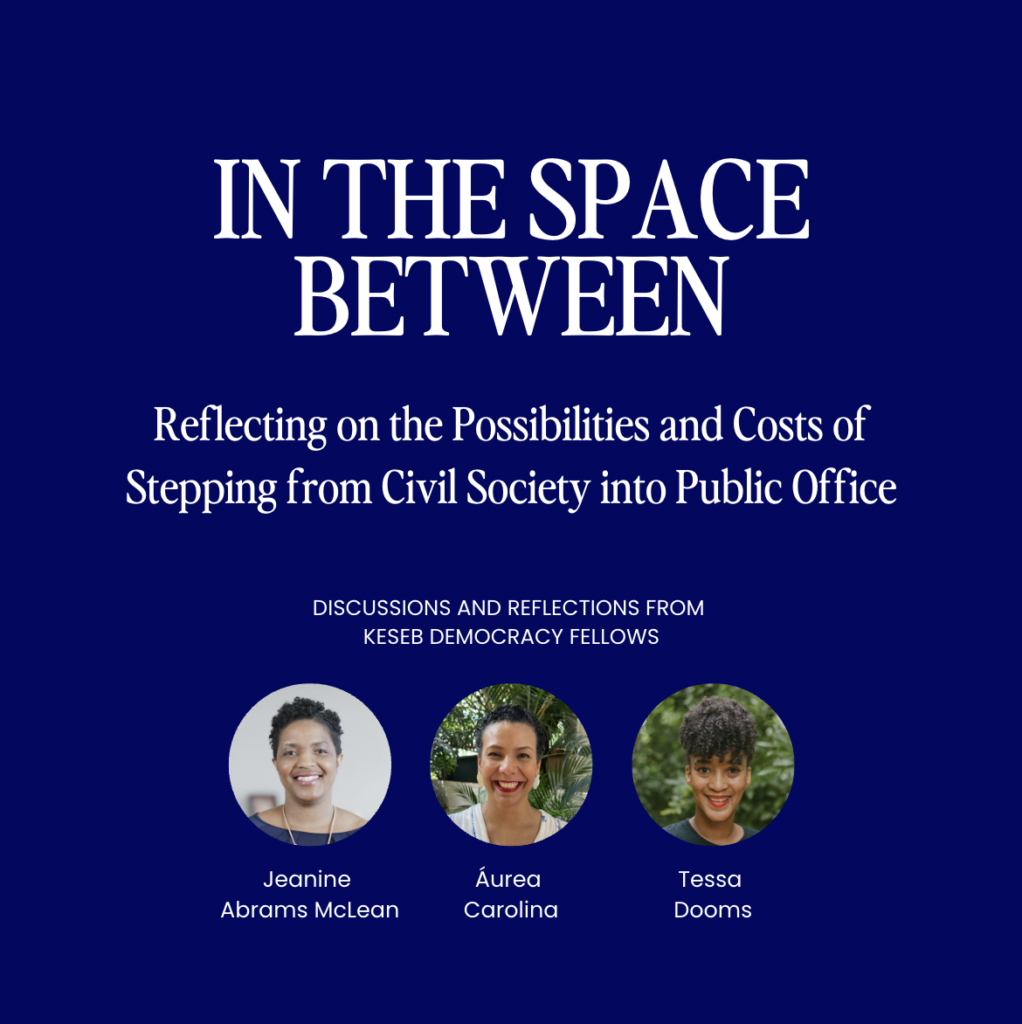
That’s the question Keseb Democracy Fellows Jeanine Abrams McLean (United States), Áurea Carolina (Brazil), and Tessa Dooms (South Africa) sat with to understand “the challenges, opportunities, and real work associated with crossing the threshold from civil society leadership to public office.”
What is the space between?
It’s “the space between civil society leadership and political power” – a change that is “far more than a career transition,” where women leaders weigh “profound emotional, financial, and structural realities” while “simultaneously discerning whether their leadership is truly needed inside the systems they have spent years trying to influence from the outside.”
From these discussions, these Fellows created a storytelling project to “acknowledge the barriers, illuminate the possibilities, and help civil society leaders not just pushing for change but shaping it from within.” The project is comprised of three videos and a reflection memo.
Keseb Democracy Fellows Jeanine Abrams McLean, Áurea Carolina, and Tessa Dooms introduce the question that brought them together and what they set out to explore: what it really takes for women leading in civil society to begin imagining a path into public office.
In discussion with Jeanine, Áurea talks about the barriers Black women in Brazil face in even imagining running for office and the profound power that representation carries. Her story makes it clear that leadership grounded in community is not only possible, it is necessary.
In discussion with Jeanine, Tessa unpacks the limits of activism alone in South Africa and how many women leaders are now realizing that shaping democracy from outside the system can only go so far.
Jeanine captured what this moment demands in a memo, exploring the reflections of women civil society leaders on the tensions, costs, and possibilities of transitioning into electoral politics during a period of global democratic crisis.
“Support for women ‘in the space between’ must be holistic. It begins with reflective spaces where they can speak honestly about their fears, motivations, and questions, because political pipelines often prioritize strategies over self-examination. It must include financial scaffolding in the form of stipends, transitional support, childcare, and fundraising coaching so that opportunity is not limited to those with wealth or safety nets. It calls for political homes that offer mentorship, solidarity, and practical guidance, because women who challenge political norms are often asked to lead while standing alone.”
– Jeanine Abrams McLean